Swapx is a Sonic DEX yield route built around concentrated pools and paid voting
In short: Decentralized exchange on Sonic where traders swap tokens and liquidity providers use concentrated pools plus paid pool voting.
Swapx is a decentralized exchange on Sonic where the yield story comes from two connected actions: supplying liquidity to concentrated pools and voting for pools that receive incentives. Traders use it for low-slippage token swaps, while liquidity providers place capital into tighter price ranges through Algebra Finance V4 infrastructure and automated liquidity management. The practical angle is simple: pool activity, fee capture, emissions, and voting payments all matter when judging a position.
Pool yield starts with where liquidity is placed
On an ordinary constant-product pool, capital is spread across every possible price. Concentrated liquidity changes that. A provider chooses a price range where the pair is expected to trade, and the pool uses that capital more intensively inside the chosen band. When the range is active, swaps route through the position and fees accrue to the provider. When price leaves the range, the position holds more of one asset and stops earning fees until price returns or the range is adjusted.
That design makes Swapx more hands-on than a simple deposit vault. A narrow range captures more fee density when price behaves, while a wider range stays active through broader movement with lower capital efficiency. Automated liquidity management exists to reduce the maintenance burden, but the basic tradeoff remains: tighter placement increases exposure to range management, and wider placement accepts less focused fee capture.
Algebra Finance V4 brings the concentrated-liquidity engine
The Sonic exchange integrates Algebra Finance V4 for the pool layer, which matters because concentrated liquidity is not just a user-interface choice. The pool contract tracks positions, price ticks, fee accounting, and active liquidity as trades move through a pair. This gives the DEX the structure needed for efficient routing, deeper usable liquidity around active prices, and more precise liquidity positions than a single pooled deposit.
For a trader, the visible benefit is execution quality. A pool with well-placed liquidity around the current market price produces less slippage for the same trade size. For a liquidity provider, the benefit is control. Swapx positions are built around the pair, range, and strategy selected by the provider or the manager, rather than a generic pool share that passively covers all prices.
Paid pool voting connects incentives to real trading pairs
The paid voting layer gives pool selection a second source of return. Participants vote for pools, and pools receiving votes become targets for incentive flow. Projects and liquidity programs use this mechanism to direct attention toward specific pairs, especially when a token needs deeper liquidity on Sonic or when a new market needs enough depth for usable swaps.
This is different from treating yield as a single advertised number. A pool's economics reflect swap fees, incentive allocation, token price movement, and the voting market around that pool. When incentives concentrate around a pair with real volume, liquidity becomes more useful to traders and more measurable for providers. Swapx uses that relationship to align pools, votes, and trading demand inside the same DEX environment.
Choosing a pool means reading volume, range, and token exposure together
A strong-looking incentive does not fix weak market structure. Before adding liquidity, the useful questions are concrete: does the pair trade, is the active range realistic, what assets will the position hold after price movement, and how frequently does the range need attention? Sonic pairs with deep trading activity give fee income more weight, while thin pairs lean heavily on external incentives.
- Volume shows whether swaps produce recurring fee flow.
- Range width determines how long a position stays active.
- Token volatility shapes impermanent loss and rebalancing pressure.
- Incentives affect short-term yield but shift as votes move.
- Automation reduces manual work but still follows the pool's market behavior.
Swapx is most useful when those inputs are evaluated together. A provider who only chases emissions misses the way a concentrated position changes asset balance as price moves. A trader who only looks at the swap quote misses the role liquidity incentives play in keeping pairs deep enough for repeat execution.
A first liquidity position on Sonic has a clear sequence
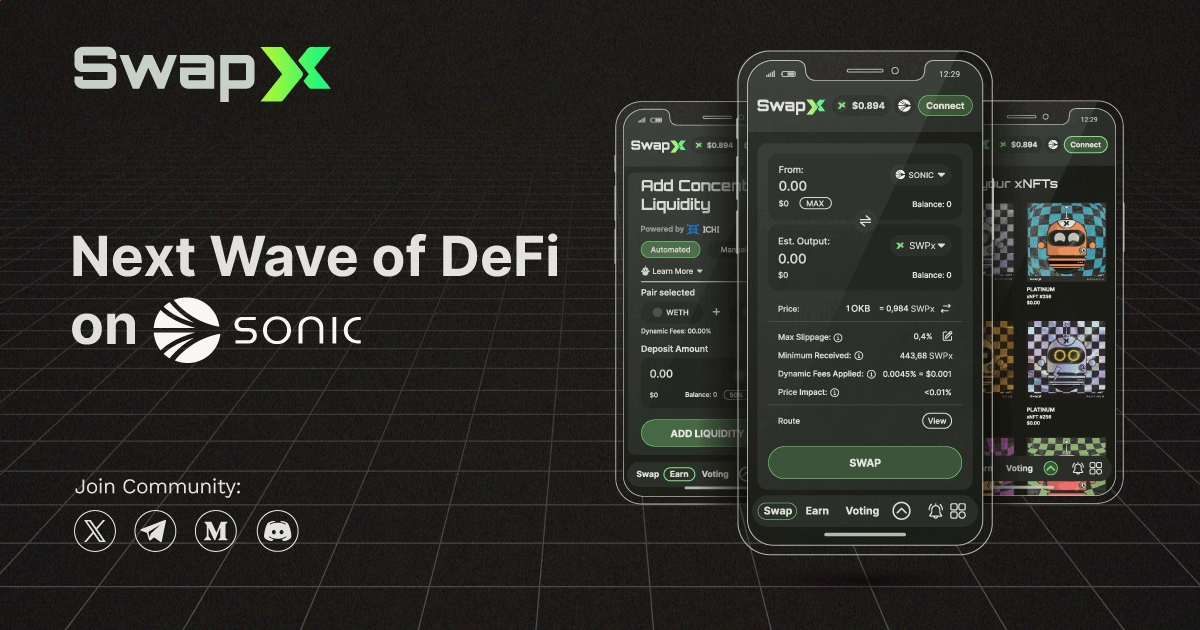
The workflow begins with assets on the Sonic network and a wallet ready to sign transactions. A user selects a pair, reviews the available pool structure, chooses a range or managed option, and confirms the deposit. After the position is live, the dashboard shows whether it is in range, what fees have accrued, and whether any incentive or voting-related rewards apply.
Position management matters after the first transaction. When the market moves beyond the selected range, the user decides whether to rebalance, widen exposure, close the position, or wait for price to return. Swapx gives the interface for that work, while the outcome comes from the selected assets and the live pool conditions on Sonic.
Trading through the DEX is about depth at the active price
Swappers care less about pool theory and more about the quote. Concentrated liquidity supports better execution when providers place capital near the current price, because the trade meets more usable depth in the range where it actually executes. That is why a pair with the same total value locked as another pair still produces a different trade result: the location of liquidity matters as much as the headline size of the pool.
On Sonic, fast settlement also shapes the trading experience. Users approve tokens, review the route and minimum received amount, and submit the swap from a self-custodied wallet. The main cost variables are the pool price impact, route quality, token approval behavior, and network gas paid in the chain's native fee asset.
Vote rewards turn governance into a yield decision
Paid voting changes governance from a purely symbolic action into a market for pool incentives. Voters direct weight toward pools, and projects compete for that weight when they want liquidity. The voter is therefore evaluating both the reward offered for a vote and the longer-term value of supporting a pool that strengthens the exchange's trading network.
The risk is that vote payments move faster than durable liquidity. A pool can attract attention for a reward cycle and then lose depth when incentives rotate elsewhere. That makes voting a shorter-cycle decision than providing liquidity to a pair with steady volume. Swapx brings both actions into one venue, but they answer different questions: one asks where incentives should flow, and the other asks where capital should sit.
Benefits that matter for active DeFi users
The clearest benefit is capital efficiency. Concentrated liquidity lets a smaller amount of assets support meaningful depth inside a selected price band. That helps traders receive cleaner execution and gives providers a more intentional way to earn from fees. Automated liquidity management adds a practical layer for users who want exposure to this model without adjusting ranges every time the market shifts.
Another benefit is that the paid voting market makes incentive demand visible. Pools with strong support show where protocols and voters want liquidity to form. For Sonic users, Swapx becomes a place to compare trading demand, liquidity depth, and incentive signals without separating swaps, pool positions, and voting into unrelated workflows.
Risks sit in the pool mechanics, not just the token chart
Impermanent loss remains the central liquidity-provider risk. A concentrated position magnifies that reality because the selected range controls how quickly the position shifts from one asset to the other. Incentive rewards offset some outcomes, but they do not erase poor range selection, weak trading volume, or a sharp move in one side of the pair.
Smart contract and strategy risk also belong in the calculation. Algebra-based pools, managed liquidity tools, token approvals, and incentive contracts each add moving parts. The specific caution is to avoid approving more token access than the position requires, especially when testing a new pair or strategy for the first time.
Where alternatives fit beside this Sonic-native route
Users comparing venues look at chain access, liquidity depth, pool design, and incentive systems. Uniswap is the reference point for concentrated liquidity on Ethereum and other major networks. Aerodrome is known for vote-directed liquidity incentives on Base. Curve remains a major venue for stable and correlated assets. Those names help frame the model, but the Sonic setting changes wallet setup, gas asset, available pairs, and incentive demand.
Day to day, Swapx stands out when the user's assets, trading pairs, and reward opportunities already live on Sonic. A cross-chain trader with most capital elsewhere starts by comparing bridge costs and liquidity depth. A Sonic-native user starts with pool quality, range behavior, and whether voting rewards make a specific pair worth attention during the current incentive cycle.
Swapx questions worth asking
What fees affect a liquidity position in Sonic concentrated pools?
A position is shaped by swap fees earned inside the active range, gas paid to create or manage the position, and any cost from rebalancing after price moves. The quoted pool fee matters, but the bigger question is whether trades actually pass through the selected range. An inactive range earns no swap fees until market price returns or the position is adjusted.
Can I earn from paid voting without providing liquidity?
Paid voting and liquidity provision are separate actions in the incentive design, although they relate to the same pools. A voter evaluates which pools receive rewards for vote weight, while a liquidity provider commits assets to a trading pair. The rewards, risks, and timing differ, so a user treats voting income and pool income as separate decisions rather than one combined deposit.
Do I need the Sonic network in my wallet before using the exchange?
Yes. Transactions settle on Sonic, so the wallet must be connected to that network and hold the right assets for swaps, approvals, gas, or liquidity deposits. If assets sit on another chain, they must be moved into the Sonic ecosystem before they interact with Sonic pools. The wallet also signs approvals before tokens enter a pool or trade route.
Which assets work best for a first concentrated-liquidity range?
Pairs with visible trading activity and assets the user is comfortable holding on either side fit better than obscure, highly volatile pairs. A concentrated position changes its token balance as price moves, so the provider should be willing to own more of either asset. Correlated pairs reduce some range stress, while volatile pairs require closer monitoring and more frequent repositioning.
Is automated liquidity management the same as passive staking?
Automated management adjusts or structures a liquidity position, while passive staking only locks or delegates an asset under a simpler reward rule. Managed concentrated liquidity still carries pool exposure, range behavior, impermanent loss, and strategy execution risk. It reduces manual decisions, but the position remains tied to market price, trading volume, and the assets inside the selected pair.