Swapx DeFi is a Sonic DEX for concentrated liquidity and paid pool voting
In short: Decentralized exchange on Sonic for token swaps and liquidity pools, with paid voting for pools and automated liquidity management.
Swapx defi is a decentralized exchange on the Sonic blockchain built for low-slippage token swaps, concentrated liquidity pools, automated liquidity management, and paid voting for pools. It uses Algebra Finance V4 infrastructure to make liquidity more precise than a flat, constant-range pool, so traders get tighter execution while liquidity providers place capital where trading activity actually occurs.
Sonic swaps built around active liquidity ranges
The main idea is simple: trades route through pools where liquidity is placed across defined price ranges instead of spread evenly across every possible price. That concentrated liquidity design matters on a high-speed chain such as Sonic because capital does more work when it sits near the live market. A smaller amount of liquidity near the current price produces deeper execution than the same capital spread across a huge inactive range.
Swapx defi uses this structure to serve traders who want efficient Sonic-native token swaps and liquidity providers who want a more deliberate position than a basic deposit-and-wait pool. The protocol's use of Algebra Finance V4 is the technical anchor: Algebra is known for concentrated liquidity and modular AMM design, and SwapX applies that toolkit to Sonic markets.
Where Algebra Finance V4 changes the pool experience
Algebra Finance V4 gives the exchange a pool engine designed for advanced DeFi mechanics rather than a plain constant-product setup. Concentrated ranges, dynamic pool behavior, and automated management features all aim at the same problem: a pool should keep usable liquidity close to the price where people are trading.
That difference affects both sides of the market. A trader swapping between Sonic assets sees less price impact when the pool has meaningful liquidity near the current tick. A liquidity provider gets a more capital-efficient position, but also takes on the discipline of understanding ranges, pool volume, token volatility, and reward structure. Swapx defi makes this more approachable by pairing concentrated pools with automated liquidity management, so the experience is not limited to users who want to adjust ranges manually every time the market moves.
Paid voting makes pool incentives part of the product
One distinctive feature is paid voting for pools. In many DEX ecosystems, pool incentives decide where liquidity gathers. A pool that receives more incentives attracts providers, which improves trading depth, which then makes the market more useful for traders. Paid voting turns that incentive allocation into a visible governance-style marketplace where voters influence which pools receive attention.
This matters because yield on a DEX comes from several sources, not just swap fees . Pool rewards, emissions, voting payments, and trading volume all shape the final return. Swapx defi places pool voting close to liquidity activity, so users evaluating a pool look at the token pair, its trading demand, the reward stream, and the voting incentives behind it.
How a Sonic user approaches the first swap
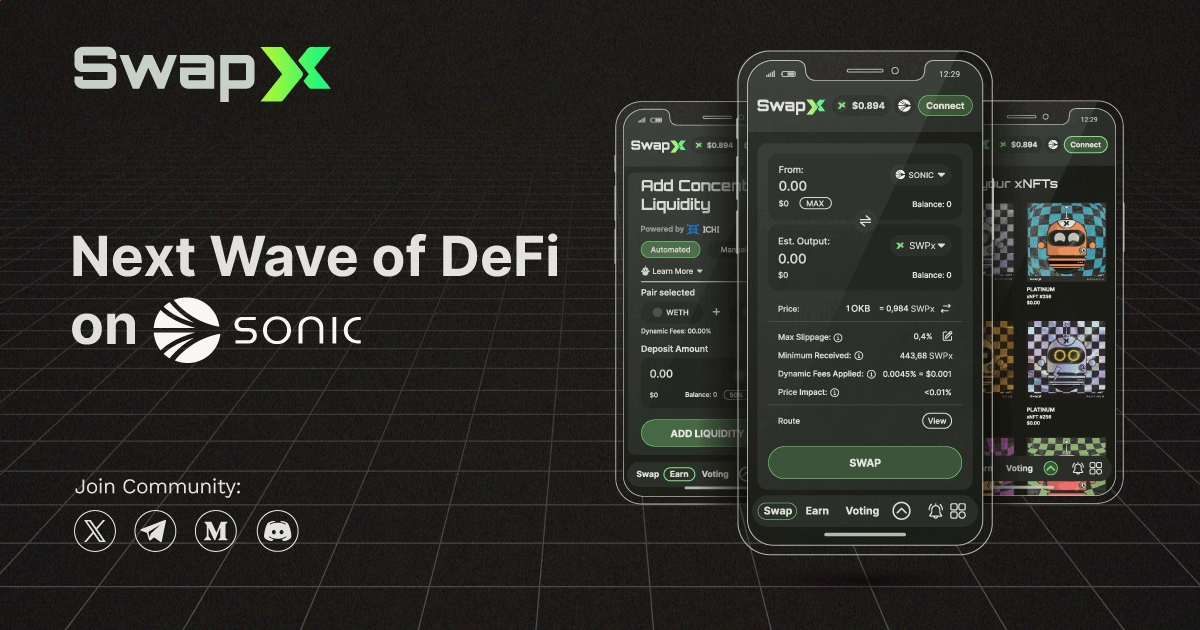
A first trade starts with a wallet connected to the Sonic network and enough native gas to pay transaction fees. The user chooses the token they are selling, the token they want to receive, reviews the quoted output, and signs the transaction from their wallet. The trade settles on Sonic, so the user keeps custody through the wallet and receives the output token after confirmation.
Useful details sit in the quote screen. Price impact shows how much the trade moves the pool. Slippage tolerance controls how much worse the final execution is allowed to become before the transaction fails. Route details show which pool or path supplies the quote. Swapx defi is built for efficient execution, but a thin or volatile pair still deserves a smaller test trade before a larger transaction.
Liquidity provision is a position, not a deposit label
Adding liquidity means supplying two tokens to a pool so traders can swap between them. In a concentrated liquidity design, the important question is where that liquidity sits. A narrow range puts more capital near the current price and earns from trades inside that zone, while a wider range stays active through more price movement with less intensity at any one price.
Automated liquidity management helps reduce the operational burden. Rather than treating every liquidity provider as a market maker who constantly resets ranges, managed strategies organize liquidity around defined behavior. The provider still needs to understand the pair: a stable pair, a volatile token pair, and a newly launched asset pool each carry different fee, reward, and impermanent loss profiles.
- Stable pools emphasize tight execution and steady volume.
- Volatile pools demand more attention to range and token exposure.
- Rewarded pools combine fees with incentive programs.
- Newer pools offer early liquidity opportunities with higher uncertainty.
- Managed ranges reduce maintenance but do not remove market risk.
Yield comes from fees, incentives, and voting demand
The yield story on Swapx defi has several moving parts. Swap fees accrue when traders use a pool. Liquidity incentives add another layer when a pool receives rewards. Paid voting introduces demand from projects and pool sponsors that want liquidity directed toward their markets. A strong pool combines real volume with rewards that do not vanish the moment incentives rotate elsewhere.
That is why annualized yield figures need context. A pool with heavy rewards and little trading volume has a different quality than a pool with steady swaps and moderate incentives. Sonic's fast settlement supports active DeFi, but returns still follow liquidity competition, token price movement, and the depth of demand for each pair.
Benefits for traders and liquidity providers on Sonic
The trader benefit is execution. Concentrated liquidity lowers slippage when depth is placed around the active market, and Sonic's chain environment keeps transactions responsive. This makes the exchange useful for token swaps, position adjustments, and moving between assets used across Sonic DeFi.
Liquidity providers get a more expressive tool than a simple full-range pool. They choose pairs, evaluate incentives, and decide whether managed liquidity suits the position. Swapx defi adds a voting layer that gives active participants another reason to monitor which pools are attracting rewards. The experience rewards users who understand pool mechanics rather than users who chase a headline yield without looking at the underlying pair.
Risks that matter before supplying a pool
The main risk for liquidity providers is impermanent loss: if the two pool tokens move apart in price, the liquidity position can underperform simply holding the tokens. Concentrated liquidity sharpens that issue because range placement determines when the position is active and how exposure shifts as the price moves.
Smart contract risk also belongs in the decision. Swapx defi relies on DeFi contracts, wallet approvals, and Sonic network settlement. Users should size approvals deliberately, keep enough gas for exits, and treat unfamiliar tokens with more caution than established assets. The risk is not abstract; a pool's token quality matters as much as its displayed reward rate.
When another route makes more sense
In most cases, Swapx defi fits Sonic users who want direct DEX swaps, liquidity positions, and pool voting incentives in one DeFi venue. Another route makes sense when the target asset has deeper liquidity elsewhere, when a centralized exchange offers the needed fiat on-ramp, or when a cross-chain aggregator finds a better execution path after bridge costs are included.
There is also a workflow reason to compare venues. A user moving from a non-Sonic chain has to account for bridge time, gas on both networks, and price movement during the transfer. Once assets are on Sonic, using a native DEX keeps the workflow compact. Before that point, the better choice depends on where the tokens already sit and how much liquidity exists for the intended pair.
What to watch as the Sonic market grows
The value of a DEX on a younger or fast-growing chain rises with the quality of listed assets, the reliability of pool incentives, and the amount of organic trading volume. Paid voting attracts attention to specific pools, but durable markets still need users who trade, protocols that build around the assets, and liquidity that remains after reward cycles change.
For context, Swapx defi is strongest when it connects these pieces: Sonic-native trading, Algebra Finance V4 concentrated liquidity, automated liquidity management, and pool voting incentives. A user who understands those mechanics can treat the protocol as more than a swap button. It becomes a place to compare pools, route trades, supply capital, and observe which Sonic markets are earning real activity.
Before you start with Swapx defi
Can automated liquidity management remove impermanent loss?
Automated liquidity management adjusts how liquidity is positioned, but it does not remove impermanent loss. The position still holds two assets whose prices change against each other. Managed strategies reduce the need for constant manual range changes and keep liquidity organized around a strategy, while the provider still carries exposure to token movement, pool volume, and reward changes.
Which token pairs make the most sense for Swapx defi liquidity?
The strongest candidates are pairs with real trading demand, understandable token risk, and incentives that match the pool's activity. Stable or highly liquid pairs are easier to evaluate because volume and price behavior are clearer. New or volatile pairs require more attention because rewards can look attractive while price movement and thin liquidity create larger position swings.
Is paid pool voting the same as staking liquidity tokens?
No. Paid pool voting is about directing incentives or attention toward selected pools and receiving voting-related payments where the mechanism supports them. Staking liquidity tokens is a separate action in many DeFi systems, where a provider locks or deposits pool tokens to earn rewards. The two activities can interact, but they are different parts of the incentive design.
Recovering from a failed Swapx defi transaction, what should I check first?
Start with the wallet transaction status on Sonic. A failed swap commonly points to slippage settings, a changed quote, insufficient gas, or token approval issues. If the transaction failed, the trade did not complete, though gas was still spent for the attempted execution. Refreshing the quote and checking token approval usually identifies the next step.